The Boy Who Spoke to Stars
In a Nutshell
Leo's curiosity about blinking stars leads him to discover the importance of careful observation. Although the mysterious blinking has a natural explanation, his work inspires classmates to explore astronomy and develop a love for science.
Introduction
The Story
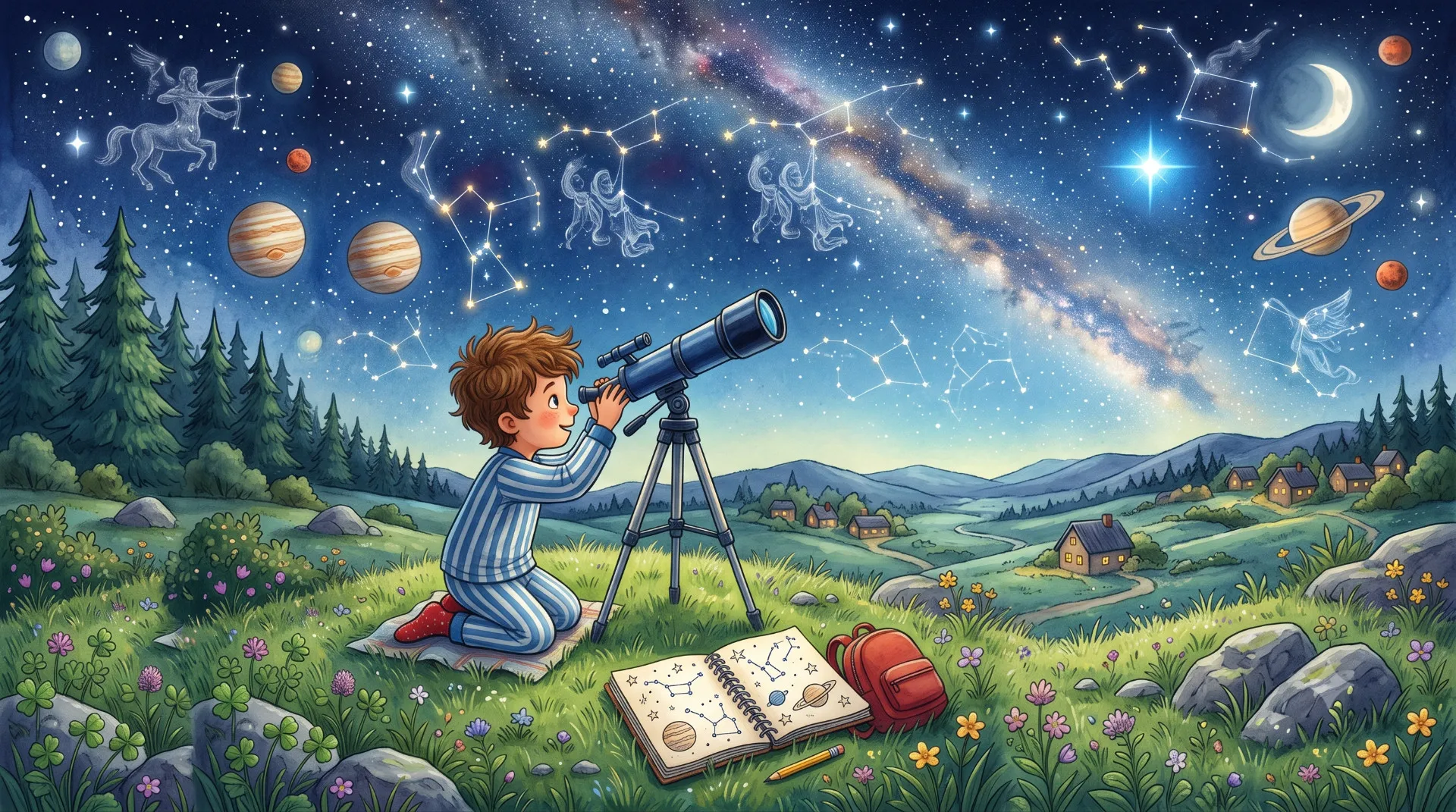
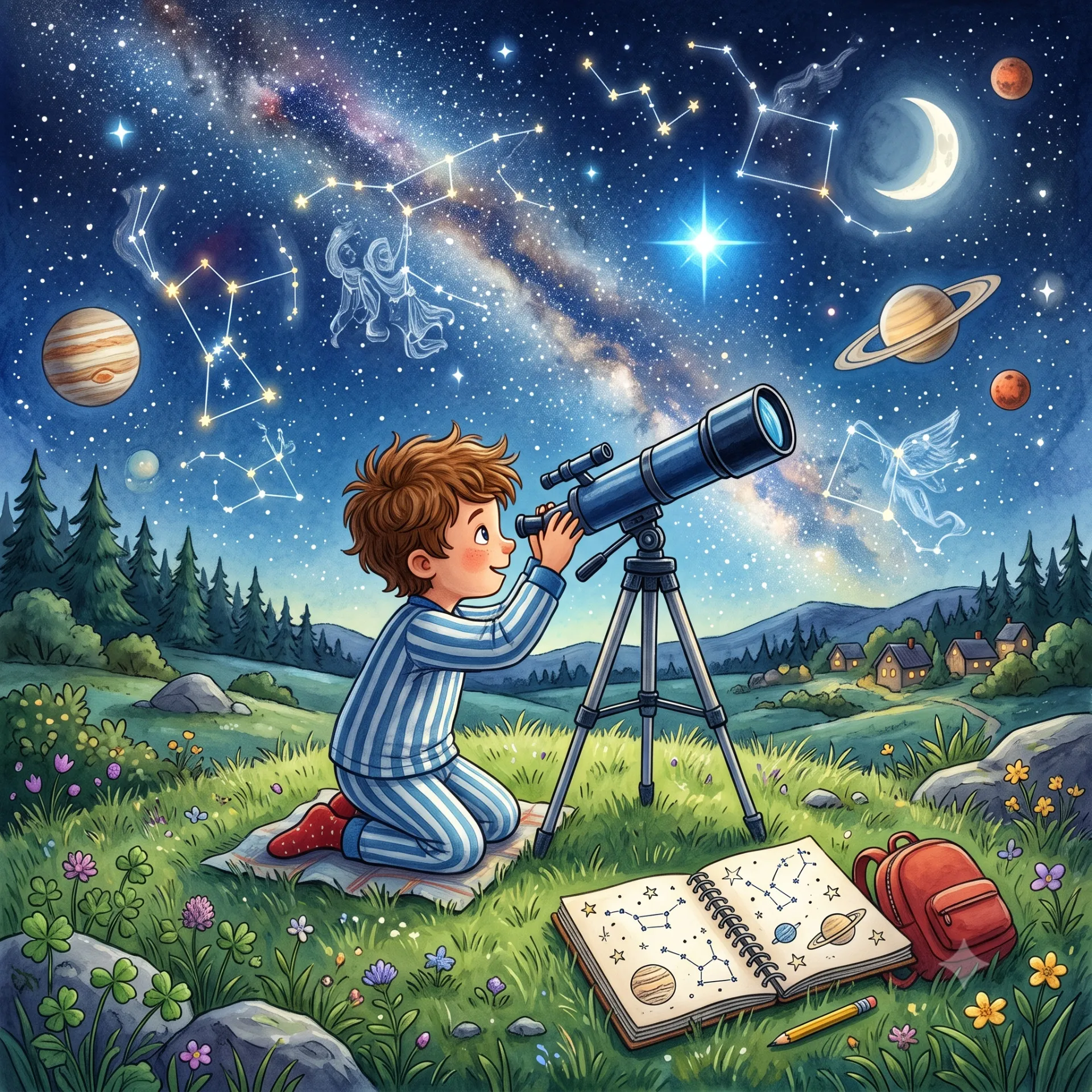
Twelve-year-old Leo loved looking at the night sky through the old telescope his grandfather had given him. While many children collected toys, Leo collected star maps, space books, and pictures of distant galaxies. His dream was simple—one day he wanted to understand the language of the stars.
Every evening after finishing his homework, Leo climbed a small hill behind his village. There, away from bright city lights, thousands of stars filled the sky like sparkling diamonds. He carefully wrote down everything he observed, including the shapes of constellations, the changing phases of the Moon, and the movement of bright planets.
One cool autumn night, Leo noticed something unusual.
A bright blue star blinked three times.
Then it paused.
A few moments later, it blinked three times again.
"It looks like a message," Leo whispered.
He opened his notebook and carefully recorded the pattern.
The next evening, the same star repeated the strange blinking.
Curious, Leo compared the pattern with the binary codes he had learned from a science book.
To his surprise, the signals matched simple numbers.
Night after night, Leo continued watching.
The blinking patterns slowly formed a sequence that represented distances between stars.
"It isn't a secret message," he realized.
"It's a map!"
Excited, Leo visited his science teacher, Mrs. Carter.
Together they used a computer to compare Leo's observations with real star charts.
The blinking star appeared to be showing the positions of nearby star clusters.
Mrs. Carter smiled proudly.
"You've discovered a wonderful way to study patterns."
Although the blinking was caused by tiny changes in the Earth's atmosphere and the star's natural brightness, Leo's careful observations helped his class understand how astronomers collect information.
Inspired by Leo's discovery, the school started an Astronomy Club.
Every Friday evening, children gathered on the school playground with telescopes and binoculars.
They learned how stars are born inside giant clouds of gas called nebulae.
They discovered that planets do not produce their own light but reflect sunlight.
They explored the differences between comets, asteroids, meteors, and galaxies.
One evening, the club watched a meteor shower.
Bright streaks of light crossed the sky.
Leo explained,
"Those aren't stars falling. They're tiny pieces of rock burning up in Earth's atmosphere."
Everyone watched in amazement.
Months later, the Astronomy Club entered a national science competition.
Instead of building a complicated machine, they presented a project called Listening to the Night Sky.
Their project showed how careful observation, patience, and teamwork could reveal amazing facts about space.
The judges loved their idea.
The club won first prize for encouraging children to explore science using simple tools and curious minds.
Years later, Leo became an astronomer working at a mountain observatory.
Every clear night, he studied distant galaxies with powerful telescopes.
Whenever children visited the observatory, Leo always shared the same advice.
"The stars may not speak with voices, but they always have something to teach those who take the time to observe."
And every time a young explorer looked up with wonder, another journey into the universe quietly began.
Vocabulary Words
The Moral
Science begins with curiosity and grows through careful observation.
Life Lesson
Never stop asking questions. Great discoveries often begin with someone simply noticing something others overlook.