The Planet Explorer
In a Nutshell
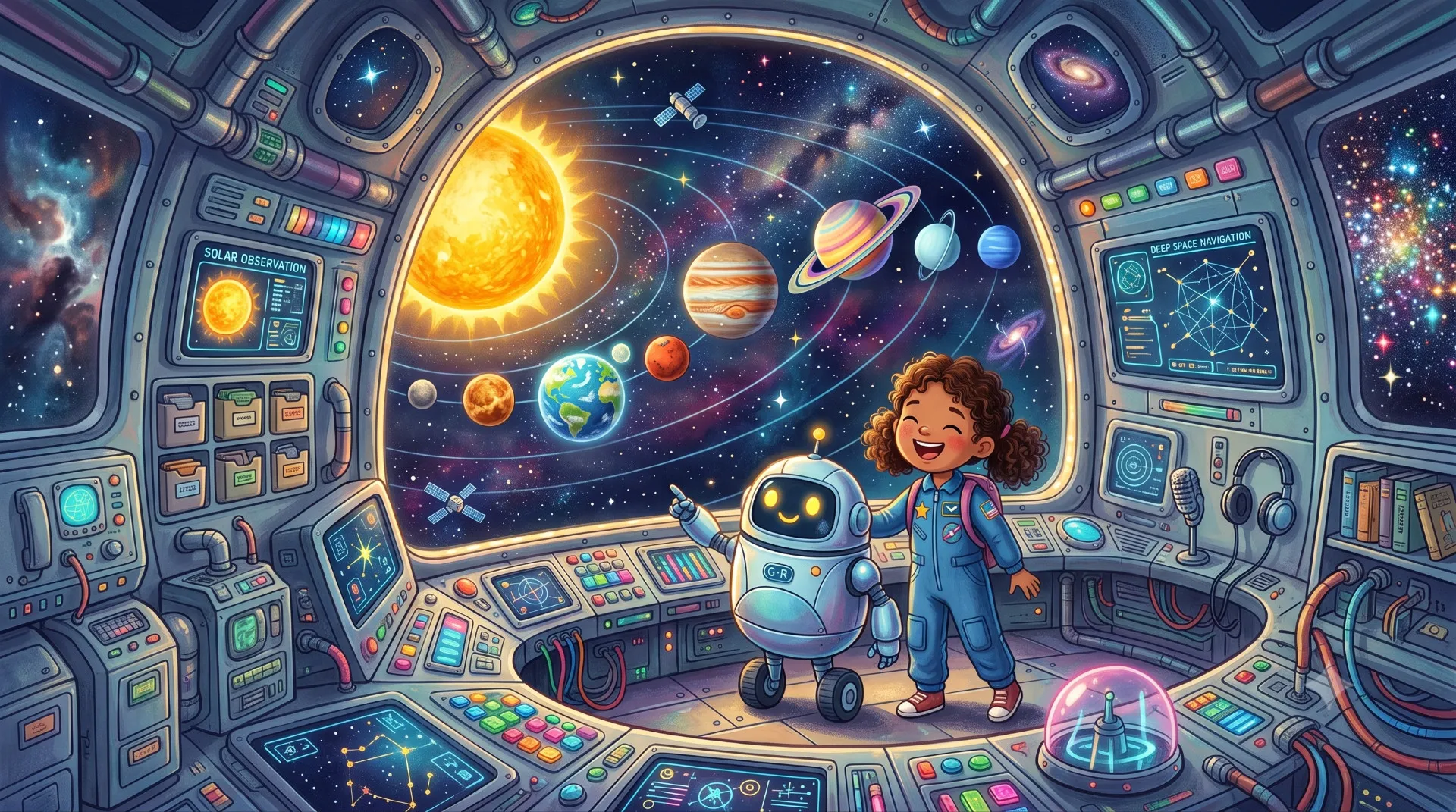
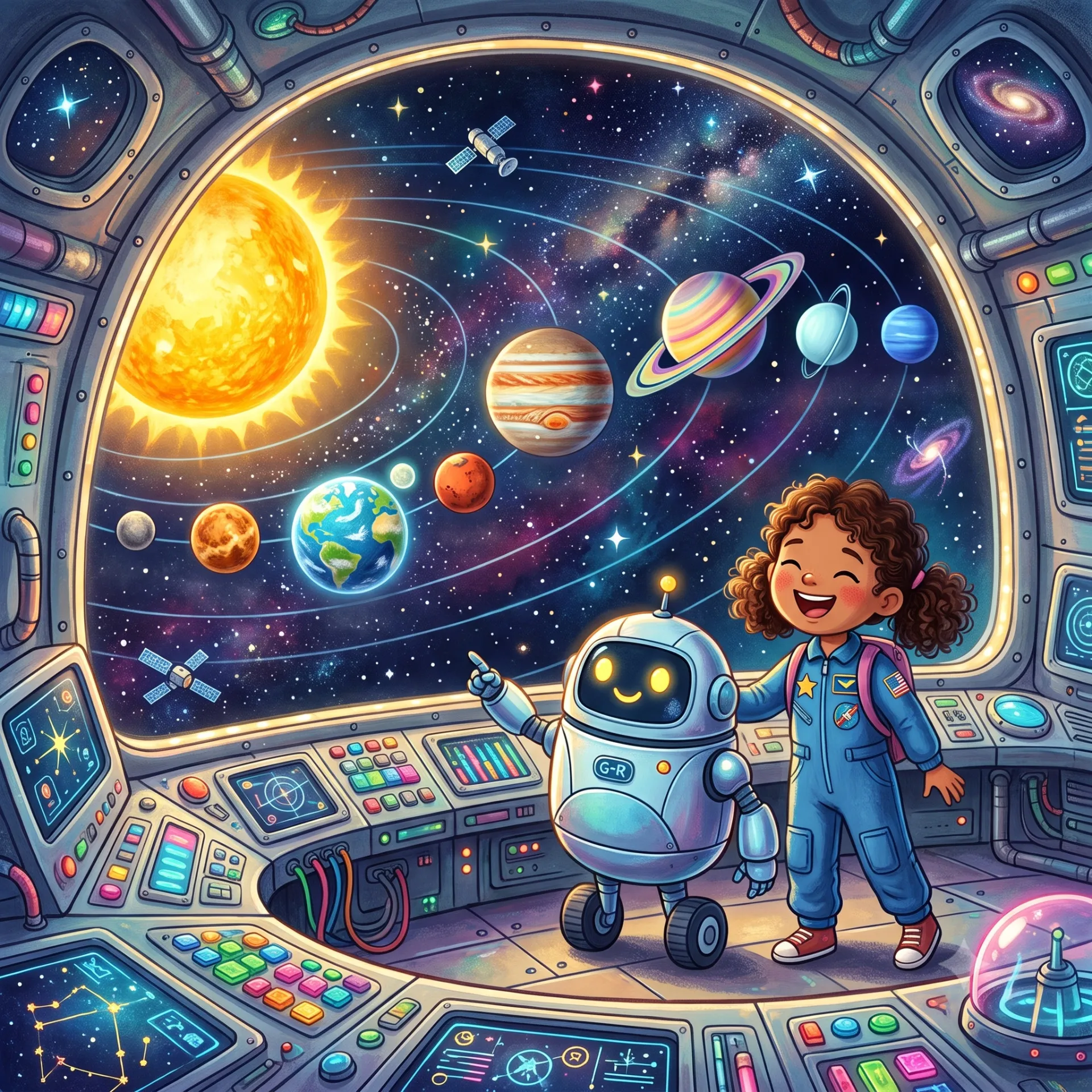
Ava boards the magical spacecraft The Planet Explorer and travels across the Solar System with a friendly robot named Nova. She visits every planet, learns fascinating scientific facts, and discovers that each world has its own unique features. The adventure inspires her to become a planetary scientist.
Introduction
The Story
Eleven-year-old Ava loved learning about planets.
Her room was decorated with glowing stars, space posters, and a large model of the Solar System hanging from the ceiling.
She often imagined visiting every planet one by one.
One Saturday morning, Ava visited the city's Space Discovery Center with her science club.
Inside the museum stood a beautiful silver spacecraft called The Planet Explorer.
A sign beside it read:
"Learning begins with imagination."
As Ava gently touched the control panel, bright lights filled the room.
The doors quietly closed.
A friendly robot appeared on a large screen.
"Greetings, Explorer," it said.
"My name is Nova."
"Today, we will travel across the Solar System."
Before Ava could ask a question, the spacecraft lifted smoothly into space.
The blue Earth grew smaller behind them.
Soon, they reached the center of the Solar System.
A giant golden Sun shone brilliantly.
Nova smiled.
"The Sun is a star."
"It gives light and heat to all the planets."
"Our journey begins now."
Their first stop was Mercury.
Its rocky surface was covered with countless craters.
"There is almost no atmosphere here," Nova explained.
"That is why Mercury becomes extremely hot during the day and very cold at night."
Next came Venus.
Thick golden clouds completely covered the planet.
"You cannot see the surface easily," Nova said.
"Venus has the hottest surface of all the planets because its thick atmosphere traps heat."
Then they arrived at Earth.
Looking through the window, Ava smiled.
Blue oceans, green forests, snowy mountains, and white clouds covered the beautiful planet.
"So far, Earth is the only known planet that supports life," Nova said.
Their next destination was Mars.
Its red deserts stretched far into the distance.
A giant volcano towered above the landscape.
"Scientists continue studying Mars because it may help us understand whether life ever existed there."
As they continued, the spacecraft entered a wide rocky region.
"This is the Asteroid Belt," Nova explained.
Thousands of rocky objects quietly orbited the Sun between Mars and Jupiter.
Soon, the largest planet appeared.
Jupiter looked enormous.
Its colorful clouds swirled around a giant storm called the Great Red Spot.
"This storm has lasted for hundreds of years," Nova explained.
Several of Jupiter's many moons circled the giant planet.
Their next stop was Saturn.
Ava gasped.
Its magnificent rings sparkled in the sunlight.
The rings were made mostly of countless pieces of ice and rock.
"It looks like a giant jewel," Ava whispered.
Farther away, they reached Uranus.
Unlike most planets, Uranus rotated on its side.
"It is often called the tilted planet," Nova explained.
Its pale blue color came from methane gas in its atmosphere.
Finally, they arrived at Neptune.
Powerful winds raced across the deep blue planet.
"It is one of the windiest places in our Solar System," Nova said.
Ava carefully looked back through the spacecraft window.
All eight planets were unique.
Some were rocky.
Some were giant balls of gas and ice.
Yet every one of them helped make the Solar System an amazing place.
Before returning home, Nova asked,
"What have you learned today?"
Ava smiled.
"I learned that every planet is different."
"And every discovery helps us understand our universe a little better."
Nova nodded.
"That is the heart of science."
The spacecraft gently returned to the museum.
The lights became still.
The doors slowly opened.
Had it all been a dream?
Or had Ava truly explored the Solar System?
Inspired by her adventure, Ava created colorful planet models for her school's science exhibition.
She also encouraged younger students to learn the order of the planets using fun memory tricks and creative drawings.
Years later, Ava became a planetary scientist.
She helped study data sent back by space probes exploring distant worlds.
Whenever children asked her why she loved space, she smiled and answered,
"Every planet tells a different story."
"And there are still many pages left for us to discover."
Vocabulary Words
The Moral
Every planet teaches us something new about the universe and our place within it.
Life Lesson
Curiosity opens the door to learning. The more we explore, the more we understand the amazing world—and universe—around us.