The Girl Who Built a Tiny Rocket
In a Nutshell
Maya dreams of becoming a rocket engineer. After her first rocket test fails, she studies the problem, improves her design, and succeeds at the science fair. Her journey teaches others that science is built on learning, testing, and perseverance.
Introduction
The Story
Ten-year-old Maya loved building things.
Her bedroom shelves were filled with paper airplanes, model bridges, toy robots, and small windmills made from recycled materials.
Her favorite dream was to build a real rocket one day.
Every Saturday, Maya visited the town library.
She borrowed books about rockets, astronauts, planets, and famous space missions.
She learned that a rocket must overcome Earth's gravity to reach space.
She also discovered that engineers spend years testing their designs before launching them.
One afternoon, Maya's science teacher announced an exciting challenge.
"Our school will host a Young Inventors Fair."
"The project should teach visitors something about science."
Maya immediately knew what she wanted to create.
"I'm going to build a model rocket that really flies," she said.
Her teacher smiled.
"Remember, good engineers always plan before they build."
Maya began drawing careful sketches.
She measured every part of her rocket.
She chose lightweight cardboard for the body, thin plastic for the fins, and safe materials approved by her teacher.
Her father helped her understand why rockets need fins.
"They keep the rocket stable during flight," he explained.
Maya tested different shapes by blowing air over small paper models.
Some tipped over.
Others flew straight.
She recorded every result in her notebook.
After many experiments, she found the best design.
The day before the science fair, Maya tested her rocket in the school playground using a safe air-powered launcher.
The rocket shot high into the air.
But instead of landing gently, it spun wildly and crashed into a pile of dry leaves.
Some students laughed.
Maya felt disappointed.
"I worked so hard," she whispered.
Her teacher walked over.
"Engineers don't stop after one failed test."
"They improve their designs."
That evening, Maya carefully examined the rocket.
One fin was slightly bent.
The nose cone was heavier than the rest of the model.
She adjusted the fins, balanced the weight, and tested a smaller nose cone.
The next morning was the science fair.
Students displayed volcanoes, robots, weather stations, and solar-powered cars.
When it was Maya's turn, she explained how rockets work.
"A rocket moves forward because hot gases are pushed downward through the engines."
"This is called thrust."
She also showed how gravity pulls everything toward Earth and why rockets need enough force to escape it.
Finally, everyone stepped outside.
The countdown began.
"Five... Four... Three... Two... One... Launch!"
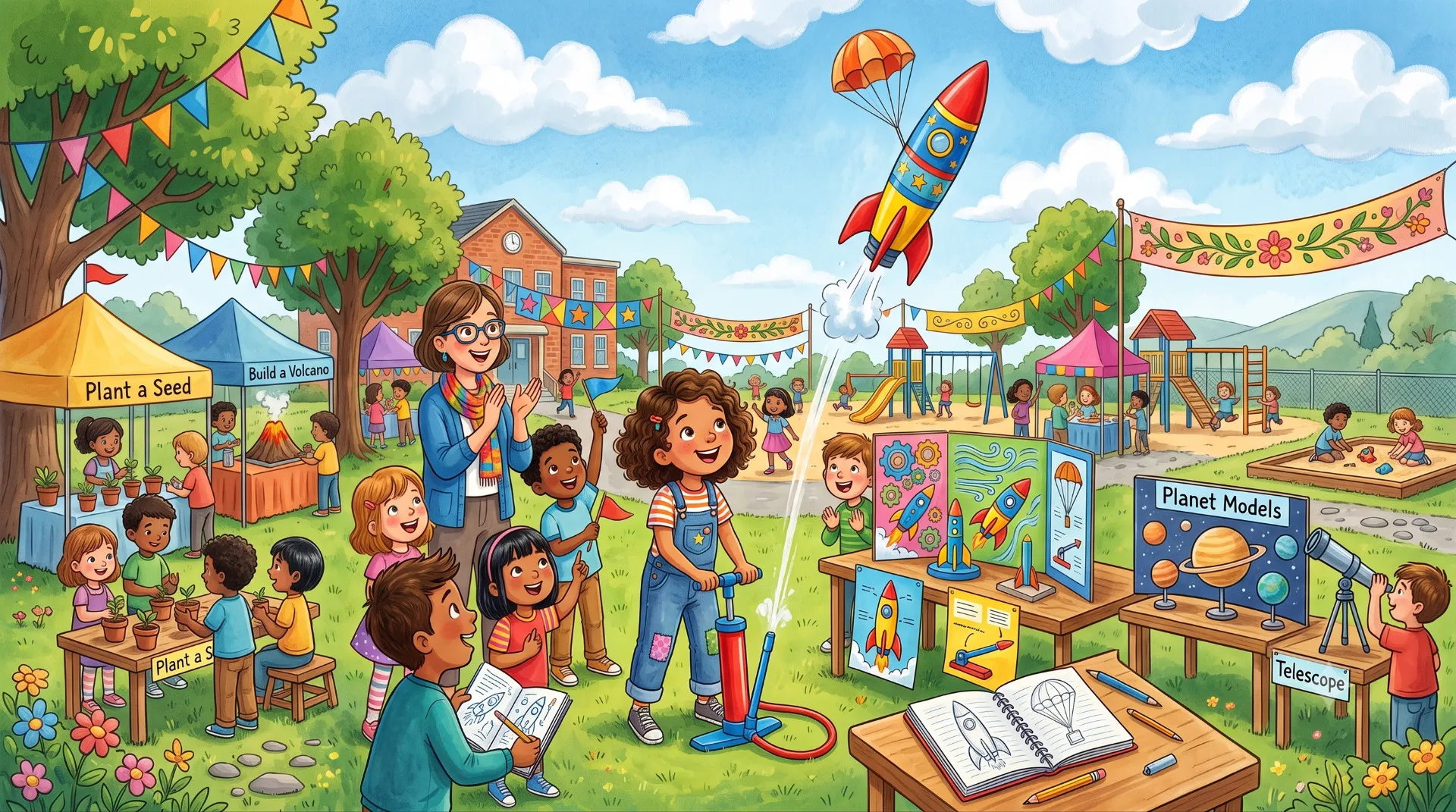
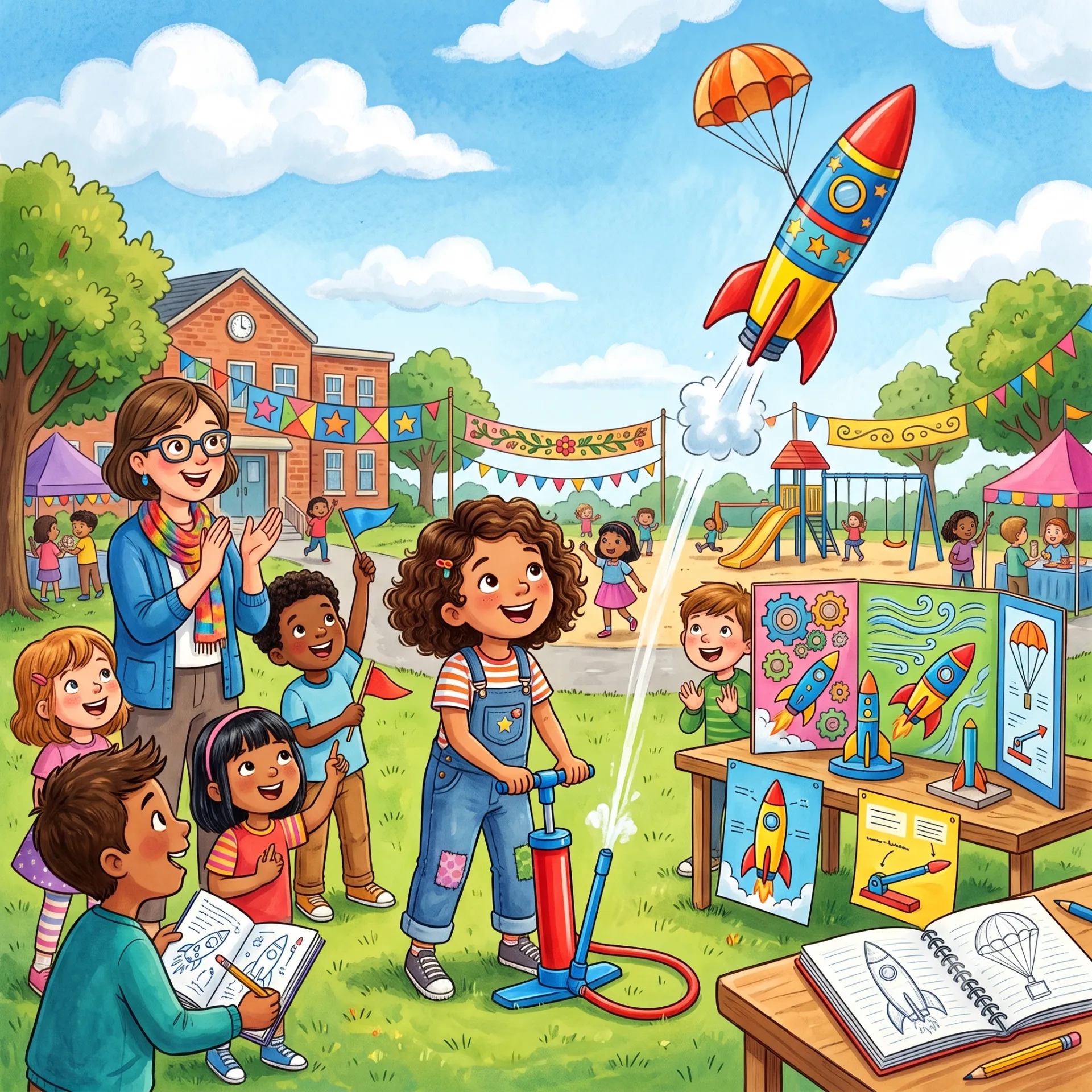
The air-powered launcher released the rocket.
It rose smoothly into the blue sky.
The fins kept it steady.
At its highest point, a small parachute opened.
The rocket floated gently back to the ground.
The crowd cheered.
The judges smiled.
Maya won the Young Scientist Award for combining creativity with clear scientific explanations.
But the best reward wasn't the trophy.
Many younger students gathered around her display.
"I want to build a rocket too," one child said.
"Can you teach me?" asked another.
Maya happily shared her notebook.
She explained that scientists learn through testing, making mistakes, and improving their ideas.
Years later, Maya became an aerospace engineer.
She worked with a team designing rockets that carried satellites into space.
Whenever students visited the space center, Maya showed them her very first paper sketch.
"It all started with one simple idea," she said.
"You don't have to build the biggest rocket today."
"You only need the courage to begin learning."
And somewhere, another curious child looked at the sky...
...and decided to start building tomorrow's dreams.
Vocabulary Words
The Moral
Science grows through testing, improving, and never giving up.
Life Lesson
Mistakes are valuable because they help us learn how to do better next time.